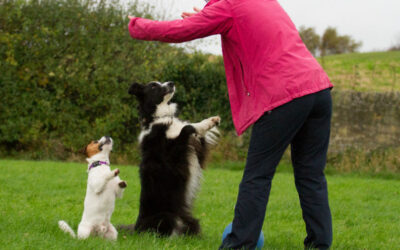
Let’s start this blog with a gratuitous video of Jellybean dying and coming back to life with enough enthusiasm to force even the most serious trainer to crack a smile. This cute trick has several components, which when broken down will hopefully make all your training more efficient.
These components make things clearer to the dog and makes our communication such that he’s given feedback every step of the way so he’s left in no doubt what I want him to do. If you’re struggling to get your dog to listen, to respond and to follow direction consistently then listen up! This blog is for you.
In each training course I run, I ask people ‘how long do you want your dog to sit for?’ This same question applies to lie down, heel, or any other position you’ve requested from your dog. In almost all cases, people have no notion of teaching duration on behaviour without shear luck, determination or a dog who stays put because it’s been nagged to do so. ‘Stay, stay, stay, stay!’ is repeated by hopeful owners who are desperate to get their dogs to hold still for seconds, minutes. How long exactly?
The answer to the age old questions is……’Until I tell you to finish!’. If you’re clear, then you’ll never struggle to get the dog to hold position, whatever that position may be. And it’s easy, without ever having to use the word ‘stay’.
Training is about clear communication. We firstly ask the dog if they can respond to a cue. This can be a verbal signal (a word) or a visual signal (body, hand or environmental). The dog performs the requested behaviour. We use a marker sound (I use a clicker, or the word OK) which clearly tells the dog that they have made the correct choice and a reward is on it’s way. However just as important and perhaps the one people struggle most with is the signal which tells the dog they can finish. They can get up, or resume whatever it was they were doing before their human interrupted them and stopped their fun.