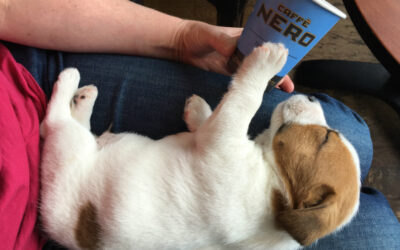
Having settled in and with socialisation in full swing last week, we scaled things down a bit this past week. Did you know that dogs go through their primary fear period between aged 8-9weeks? This means that major upheaval during this time is not a great idea and can cause upset at best and lasting damage at worst. It’s during this period that social bonding is done between dog and human, which is one of the reasons it’s recommended that pups are re-homed around 8 weeks of age. After all, most people want their pup to bond with them, not the breeder? Being mindful of his age then, this week Jellybean and I have revisited some social situations he had already experienced, met a few new people in his own home (more relaxed for him) but in general, we haven’t done much this week that’s entirely new to him.
Instead, at home this week, we’ve focused on laying down some foundations for training. At this age, puppies are learning how the world works and how they get feedback from it. Behaviours that are worth their while (resulting in reward) are strengthened and are likely to be repeated. Behaviours which don’t result in benefit to them, are forgotten about or extinguished. So if being a little rough with my cat gets Jellybean a clobber (punishment), he’s less likely to repeat the exercise. If running after my cat results in the thrill of a chase (reward) he’s more likely to repeat this exercise. Puppies are like sponges and generally pick up what WE teach them, or if left to their own devices, what they teach themselves. So now is a good time to start the basics of training.
I’m not a fan of teaching loose leash. I’d rather be running with my puppy in a field and playing tuggy or search, than plodding along a pavement with a leash connecting us. Last week I’d encouraged an off-leash follow and walk my side (as part of bonding), but this week we needed to start dreaded loose leash training.
From the outset, I want putting on Jelly’s harness to be stress free. All too often, by the time the owner realises that puppy hates being handled, each time an owner tries to take puppy for a walk, biting of human hands and grabbing the puppy has become habit. Step 1 then, is, using the clicker/food combination, to teach Jelly to sit, to have his harness put on/taken off. As with all training, the aim is to have a compliant and happy puppy who is actively involved in the training. It should be his choice to play the game. Step 2 is learning that a tight leash won’t gain access to what puppy wants, to learn that pulling doesn’t work. Remember behaviours that aren’t rewarding to Jelly, are less likely to be repeated. Step 3, is to teach Jelly that we only move forward on loose leash and that the food delivery station is by my heel. So it’s worth his while hanging around this area rather than elsewhere. You can follow Jelly’s progress step by step, in this training video.